We’ve talked about the differences that companies experience when they grow and when they scale. We also touched topics regarding...
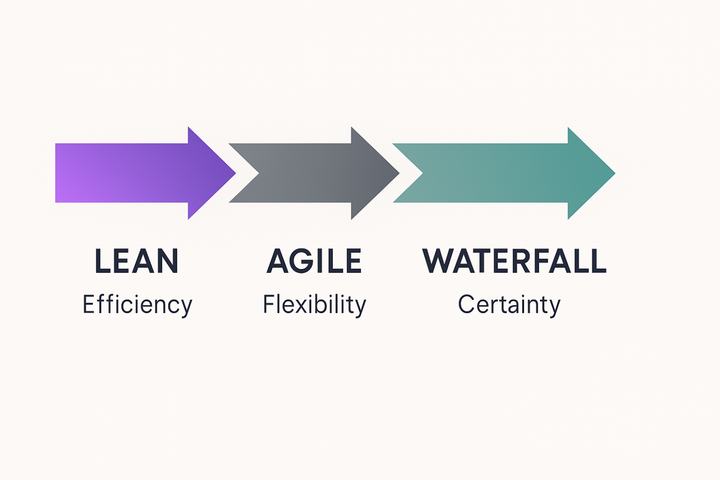
We’ve talked about the differences that companies experience when they grow and when they scale. We also touched topics regarding processes and now I believe it’s time we differentiate a few of my favorite methodologies - Lean and Agile and mention another classic - Waterfall.
Now, Agile is a very famous methodology, especially in IT, software startups and even small marketing teams. But the question is: when should you use Agile and when should you use different methodologies like Waterfall or Lean?
All frameworks promise speed, efficiency, and smarter execution.But they serve very different goals and knowing which fits your business stage can make or break your next phase of growth.
Let’s break it down.
What Waterfall Is (and Where It Fits)
Before Agile and Lean reshaped modern operations,Waterfall was the dominant approach, especially in industries like construction, engineering, aerospace, and traditional IT.
Waterfall is about linear, sequential progress: that means that every phase (planning → design → execution → testing → delivery) must be completed fully before the next phase begins. There’s minimal room for mid-course corrections.
Imagine constructing a building: You don’t pour concrete before the blueprint is finalized. Every decision builds on the one before it, and changing direction halfway through can be extremely costly.
That said, Waterfall excels when predictability, control, and risk management are non-negotiable.
This methodology fits best when:
✅ Requirements are clear, stable, and unlikely to change
✅ Projects must meet strict budgets, timelines, and compliance standards
✅ Deliverables need to be fully finished before they have value
✅ Rework would be costly, dangerous, or reputationally risky
One thing you should be aware of is that Waterfall also comes with tradeoffs: If a customer needs some kind of change mid-project, or if the initial requirements were wrong—there’s little flexibility to pivot without major disruption.
In a nutshell: Waterfall thrives when certainty matters more than speed or flexibility.
What Agile Is (and Where It Fits)
Agile emerged in the early 2000s as a response to Waterfall’s rigidity, especially in industries where customer needs evolve fast and innovation speed is critical.
At its core, Agile focuses on adaptability, iteration, and continuous customer feedback. Instead of delivering one big, finished product at the end, Agile teams build in small increments, test early, and adjust based on real-world results.
Picture a startup building a new mobile app: Instead of disappearing for six months to “perfect” the product, they launch a minimal version in a few weeks, gather user feedback, and refine based on what the market actually wants.
But Agile is more than just daily stand-ups or sprint planning sessions. When using this methodology, the mindset is the following:
Embrace change instead of resisting it.
Stay relentlessly close to the customer.
Value working solutions over polished plans.
Prioritize collaboration across disciplines.
That said, Agile fits best when:
✅ Innovation is rapid and customer needs are evolving
✅ Flexibility matters more than upfront certainty
✅ Early feedback is critical to success
✅ Teams need to move fast, adapt quickly, and test hypotheses
However, same as any other methodology, Agile isn't risk-free. Without strong strategic anchors, Agile teams can fall into constant pivoting chasing every new idea and losing momentum over time. Good Agile leadership requires disciplined flexibility: adapting without losing focus on the bigger strategic goal.
So, in a nutshell: Agile is about learning faster than you can plan and using that learning to deliver real value quickly.
What Lean Is (and Where It Fits)
The time has come to talk about my personal favoriteand that is the Lean methodology.Lean takes a different angle altogether: It’s not just about speed or flexibility, it’s about maximizing value while minimizing waste.
Originally developed in manufacturing (most famously by Toyota), Lean is now a powerful approach across industries, from SaaS to healthcare to services.
Lean thinking asks: “Where are we wasting time, money, energy, or customer goodwill and how can we eliminate it without sacrificing quality?”
Imagine reviewing your customer onboarding process and realizing that 30% of the time is wasted on unnecessary approvals. A Lean approach would systematically redesign that workflow to remove friction while protecting the outcome.
Lean is grounded in continuous improvement (Kaizen): Instead of waiting for big overhauls, Lean businesses make small, consistent changes that accumulate into major gains over time.
Lean fits best when:
✅ You’re optimizing internal workflows and delivery systems
✅ You want to scale efficiently without bloating your team
✅ Efficiency, customer value, and margin improvement are priorities
✅ You need sustainable, repeatable, operational excellence
Importantly, Lean isn't about "doing more with less" in a way that burns teams out. It’s about doing better with less wasted effort building systems that allow people to focus on meaningful, value-driven work.
In short: Lean helps businesses grow smarter, not just bigger, by relentlessly removing friction from how work gets done.
Choosing the Right Approach: It's About Fit, Not Trends
One common mistake I see is companies forcing themselves to follow the latest "trendy" methodology without considering what they actually need operationally.
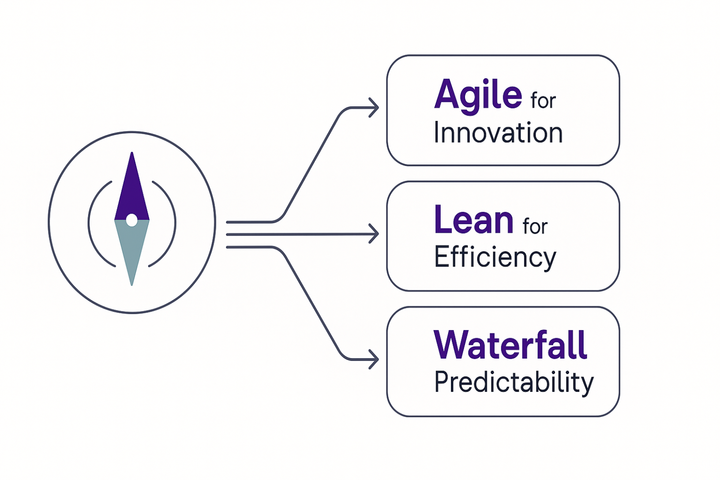
In reality, you may use different frameworks for different parts of your business.
Your product teams might operate in Agile sprints.
Your customer support or service delivery teams might run on Lean principles.
Your long-term compliance projects might follow a Waterfall model.
Smart leadership isn't about loyalty to a framework. It’s about choosing the right one for the right situation, at the right time.
How We Help Clients Apply the Right Framework
When I work with founders and leadership teams, I always ask two foundational questions:
Are you trying to innovate, or stabilize right now?
Where is operational friction slowing your business down?(if they don’t know, we are determining where in the system they have bottlenecks together)
From there, we build lightweight systems using the needed methodology that fits the business stage, market demands, and leadership goals.
At the end of the day, no single framework is a silver bullet.
Each one offers powerful tools. Each one can fuel smarter, faster, more sustainable growth. The trick is to apply them with clarity, intention, and the flexibility to evolve as your business evolves.
Because frameworks alone don’t scale companies.People do. Teams do. Systems do.
The real operational advantage isn’t choosing Agile because it’s trendy, or Lean because it sounds efficient, or Waterfall because it’s safe. The real advantage is understanding your business stage, your goals, your risks and designing operations that match your reality.
When your operational systems align with your vision and your growth pace, you stop firefighting and you start leading.
📩If you're trying to figure out which framework, or combination of frameworks, fits your next stage of growth, let's connect.You can book a discovery call HERE.
Handed a team but never a real leadership foundation? That is what The Rising Leader is built for.
Explore The Rising Leader →